

Doble Agente
The method for salaried executives
For two decades you built your career at large companies. This book helps you turn that experience into your own income, step by step and without hiding it from your employer.
The book and the workbook are in Spanish.
A plan to get paid for what you already know how to do
If you run a department, you know how to solve problems that cost other companies hundreds of thousands of dollars. What's usually missing is a plan to get paid for that outside your job, and for the day a restructuring changes what you had planned.
Four executives from Lima, Bogotá, Mexico City and Santiago work through the method with numbers you can check. Each chapter ends with a workbook template and three actions for the week.
- 01Work out how many months your household can last without a salary and build your exit plan.
- 02Find USD 100,000 problems your market would pay to solve today.
- 03Price your first part-time role and sign your first contract without a conflict of interest.
- 04Go from one role to a portfolio and measure when you reach the point of no return.
The method in 21 ideas
- Manifesto: two roles in the open
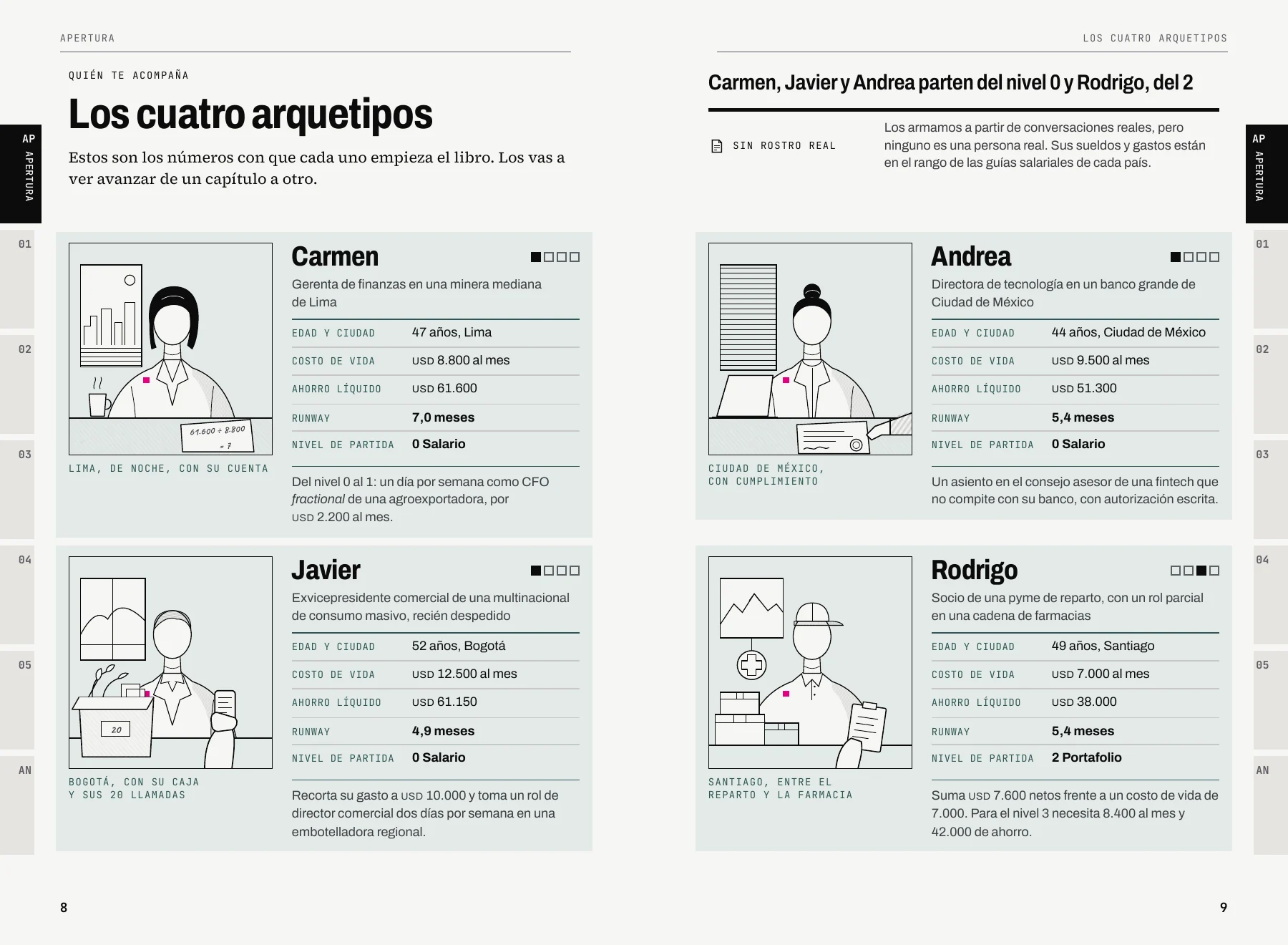
- The four archetypes
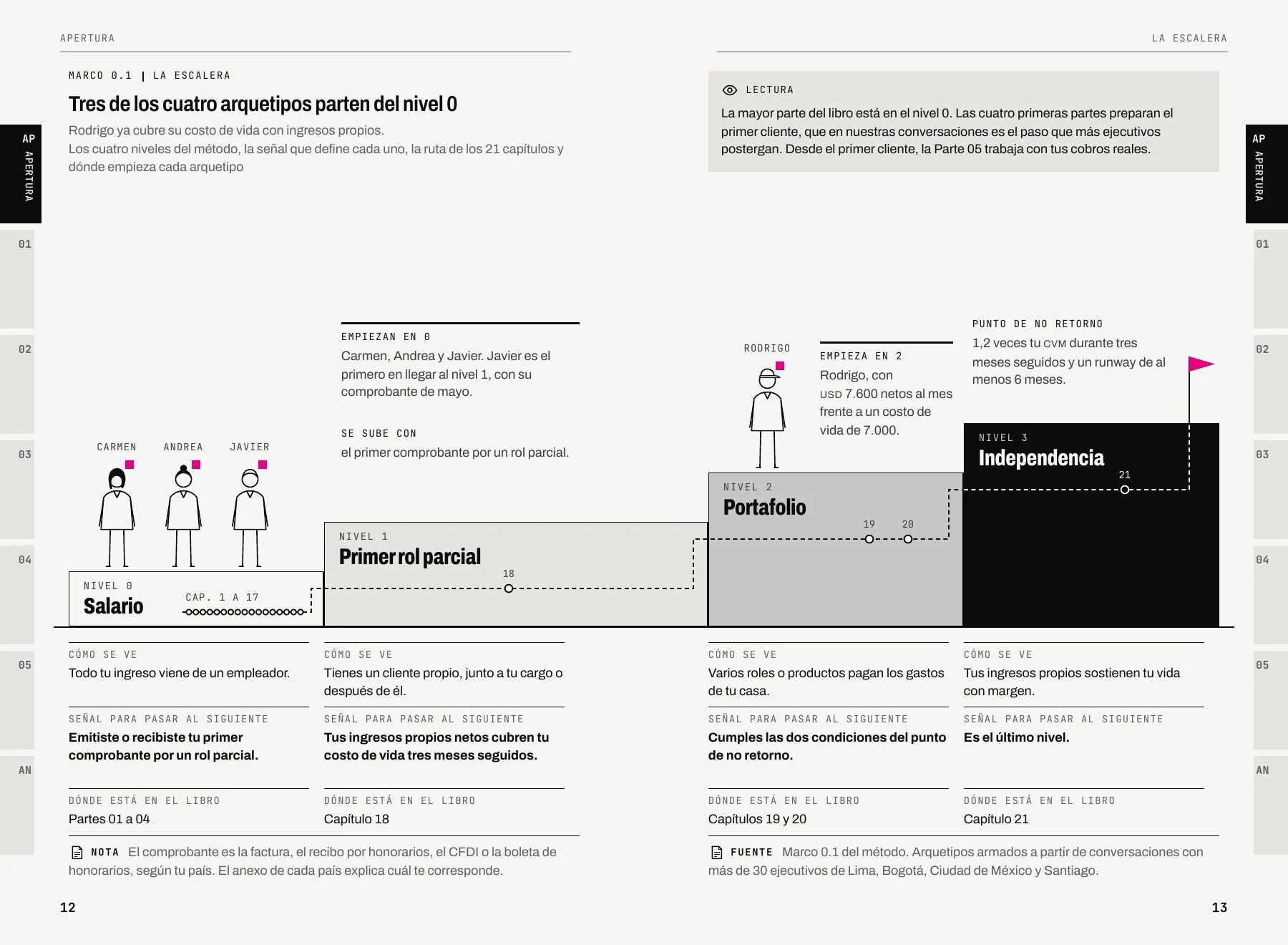
- The ladder: from one salary to several incomes
- How to use this book
- K“Exit plan” kit, templates K.1 to K.5
- 1
The risk you don't see
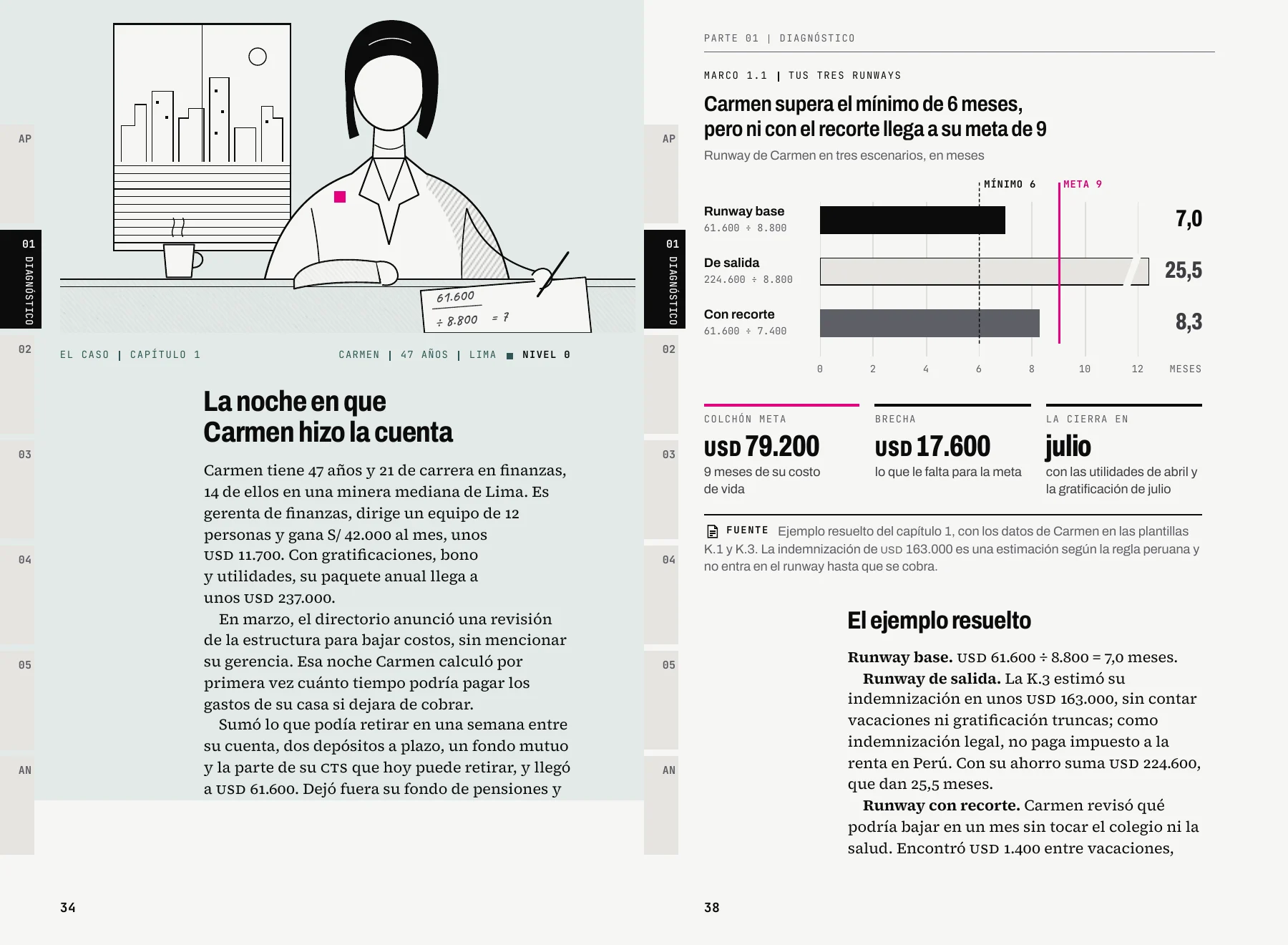
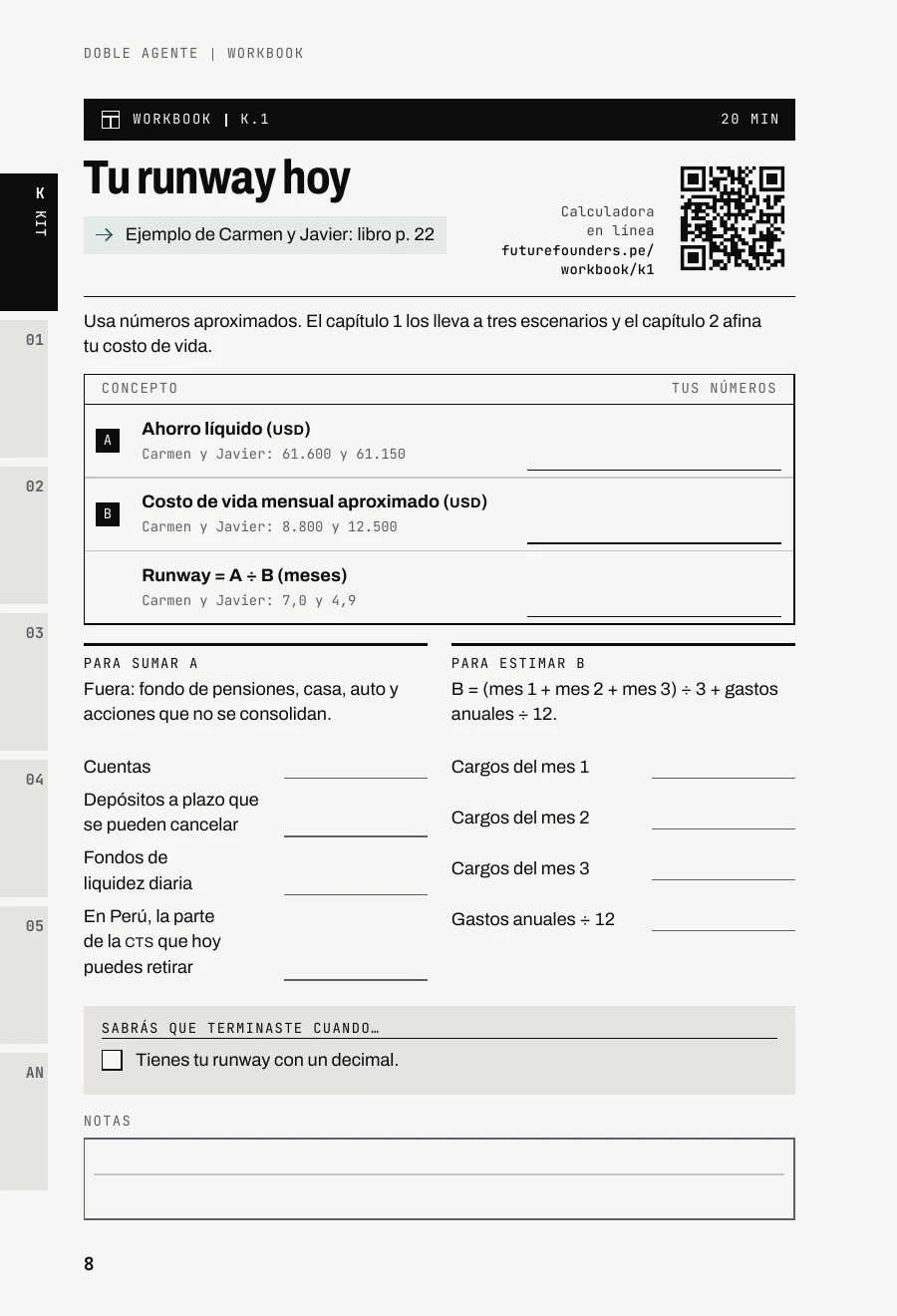
Your first number is how many months your household can last without your salary. You calculate it in three scenarios, pick a goal and decide the month you'll reach it.
- 2
Your real cost of living
Your cost of living has three versions and each one is for something different. The one that matters for your plan is the one you would have without your employer, because that's the one you'll pay with your own income.
- 3
Your executive judgment is sellable
Outside your company you sell your judgment to solve a type of problem. Its reference price is the market salary for the equivalent role at the companies that have that problem. Your current salary is only there for comparison.
- 4
Fair play: contract, conflict of interest and transparency
What's yours can be sold: your judgment, your network and your free time. What belongs to the company, such as its data, its clients, its internal information and your working hours, stays out of any role of your own. When you don't know which side something is on, you ask for written authorization before you start.
- 5
If you're let go tomorrow
Your savings turn into a month-by-month cash flow, with two scenarios, and you set a decision line in writing: the date and the balance at which you trigger a plan B. You agree on it at home in the first month, while you still have most of your runway left.
- 6
The USD 100,000 problem
Offer to solve a problem that costs your client at least USD 100,000 a year and that you've solved before. That way your fee fits the book's value rule, which asks that your work be worth at least five times what you charge over 12 months.
- 7
Your entry point
Start with a small segment where your problem weighs the most and where you can reach clients in person. Once you have clients in that segment, you can show their results to neighboring segments that buy for the same reason.
- 8
Who decides and why they buy
A company buys through several people with different concerns. If you know who each one is and what they want to achieve, you know what to show, to whom and in what order.
- 9
Is the market big enough?
For a part-time role the market is usually big enough, because you need one or two clients and what limits you is the time to talk with them. If you need several roles soon, like Javier, do the same math with the number of roles and the sales timeline from chapter 8. For a product, the math of how many clients you need against how many exist decides whether it's worth building.
- 10
Your value proposition, in numbers
Your price has a ceiling and a floor. The ceiling is set by the value rule: what your work saves or earns the client over 12 months has to be at least 5 times what they pay you. The floor is set by your floor cost of living, because below a certain fee your household wouldn't hold up even if you filled your week with clients.
- 11
Your first part-time role: format, price and contract
Your first role fits on one page with six parts: the problem, the result with its figure, the format and time commitment, the price, the duration and the contract terms. The price comes from the market salary for the equivalent role at the client company, prorated to your days and with a premium for the risk of being independent.
- 12
From service to product
A product comes from the part of your service that repeats the same way with every client. You package it with a fixed scope, price and format, and you validate it by charging a few clients before you build all of it.
- 13
Unit economics
A client is worth what they leave you over the whole relationship, after paying what it costs to serve them. They're worth winning if that's several times what you spend to win them. After that per-client math, you add the fixed cost that rises with volume and the tax, and you see how much reaches your pocket.
- 14
Your network as a channel
Your network works as a sales channel when you treat it as a list of accounts: companies with one person you know in each, an order for writing to them, a message about a problem and a follow-up that's useful to the other person.
- 15
The diagnostic conversation
In a diagnostic conversation you ask about past facts and their consequences, and you let the client calculate how much their problem costs them. The proposal comes later, when they ask you for it.
- 16
The first contract and the first invoice
Your first contract protects both parties if it says what you do, how much you charge, how it ends and what you won't do. Your first invoice opens your obligations with your country's tax authority, which continue with your tax returns, and marks your arrival at level 1.
- 17
Your schedule, your energy and your family
The hours of your plan are set in your calendar and agreed at home before they're needed. What doesn't fit in eight hours a week is delegated or put off.
- 18
From first role to portfolio
A portfolio is a set of roles you track together every month with four figures: net income, days it takes, weight in the total and renewal date. You arrange it so that losing one client doesn't send you back to level 1. The level 2 signal requires three months in a row covering your cost of living without a job, and the month you stop covering it you're below again, so you review the dashboard on the first day of each month.
- 19
The point of no return
You reach the point of no return when you meet two conditions at the same time. Your net own income is at least 1.2 times your cost of living without a job for three months in a row, and your cushion covers at least six months of that cost. With both met, going back to a job becomes a choice you make with your numbers, and that month you start level 3.
- 20
The conversation with your employer
The conversation with your employer goes better if you arrive with your numbers, offer an orderly transition and propose what you could keep doing for the company under a services contract. Your employer has something to solve, such as an integration, a replacement or a handover, and your offer can be part of that solution.
- 21
Independence: make the leap or stay
Independence holds up with a monthly review of your numbers and a 90-day plan that lowers your biggest risk. Staying in your job with an income of your own is also a complete plan, as long as you decide it with written criteria and a date to review it. Both decisions use the same figures from chapter 19.
- What comes next
- Country appendices: Peru, Mexico, Colombia and Chile
- Glossary and indexes
Each chapter opens with a case and closes with its template
In between, a named framework explains the idea with numbers.
The book explains the method and the workbook is where you apply it
The templates that do math have their own online calculator.
- “Exit plan” kit
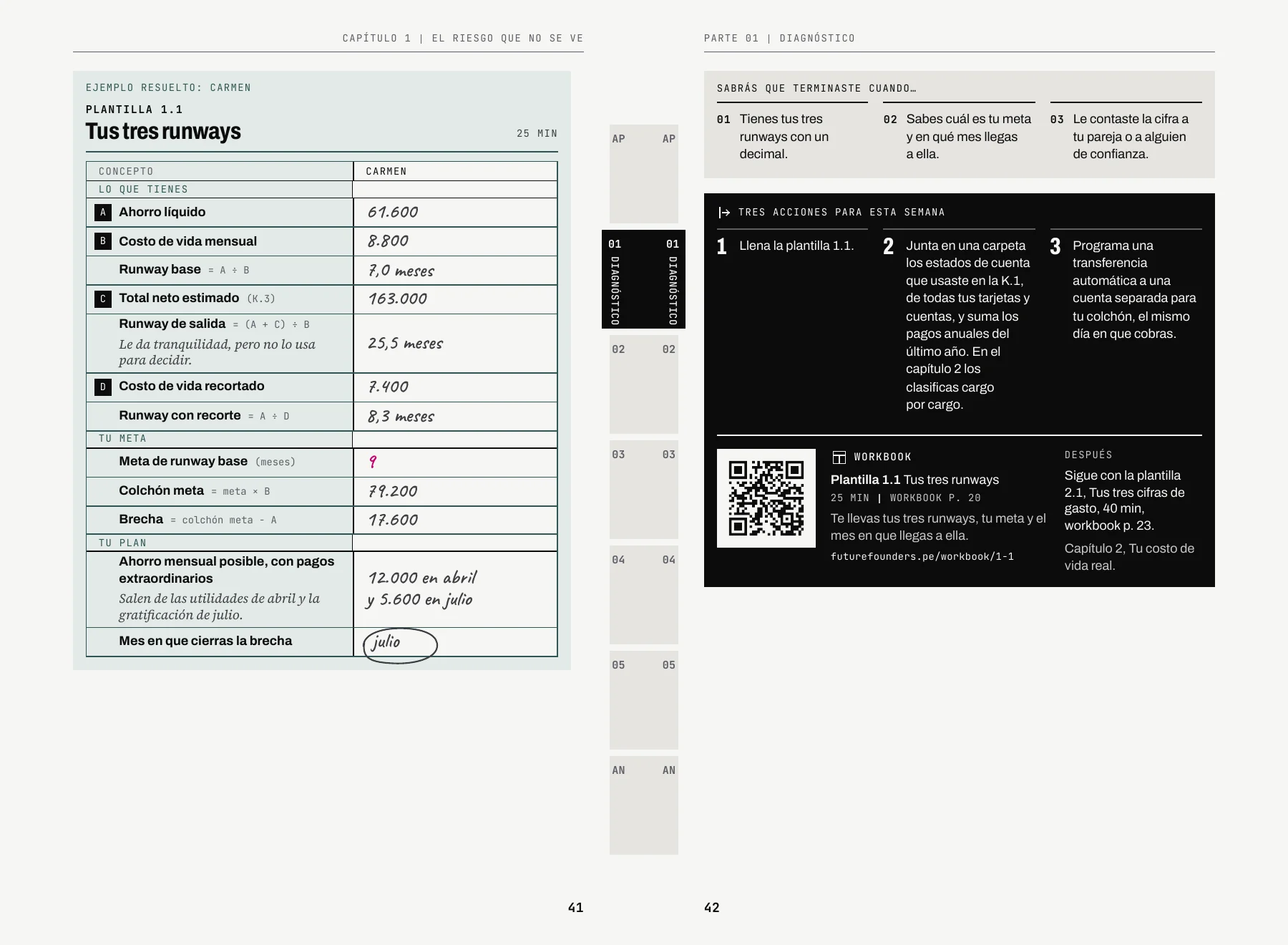
Five templates, K.1 to K.5, for your runway, your contract, your exit, your first 30 days and your first 20 calls.
- 21 templates, one per chapter
Each takes 15 to 40 minutes with your data at hand and leaves you with a decision or a new fact about your situation.
- The three actions of each chapter
What you do that week, in writing and with a date.
- The calculations for the four archetypes
Written by the founders of Future Founders

Eddie Ajalcriña
Lecturer at MIT Professional Education since 2022

Lorenzo Ortiz
Ebook and paperback on Amazon, PDF with Mercado Pago
The PDF edition will be paid with Mercado Pago: credit card, debit card or account balance. While we set up online payment, you can order the PDF on WhatsApp. All three editions are in Spanish.
Ebook and paperback
The ebook reads on Kindle, a tablet or a computer. The paperback is an executive pocket edition, 150 × 220 mm, printed by Amazon.
Everyone starts from a different salary, savings and market, and the book helps you measure yours.
Start before you buy
The “Exit plan” kit is the first hands-on section of the book and you can download it for free. If it helps, the book picks up from there with Part 01.